Classrooms have been among the most formative spaces in my academic life. They shaped how I learned to think, how I found intellectual community, and how I came to understand education as a source of social mobility. I approach teaching as intellectual work: explaining an idea clearly and making abstract concepts usable often deepens our own understanding of them.
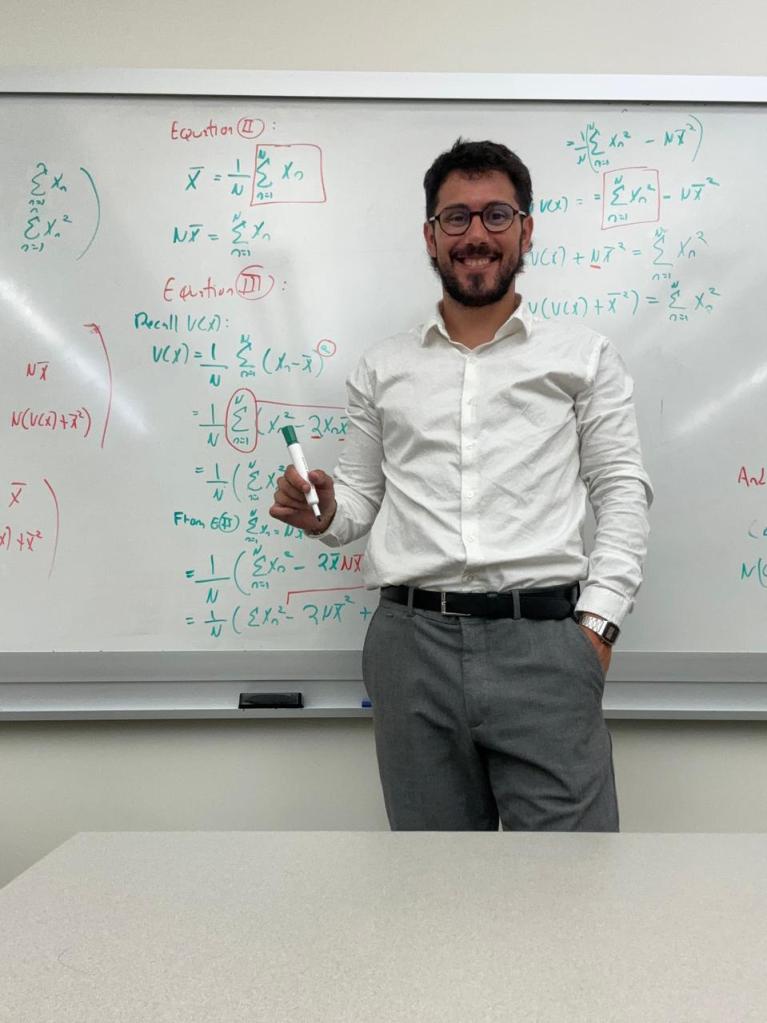
At Vanderbilt, I have served as a teaching assistant across the graduate quantitative-methods sequence, including Statistics for Political Research I and II and advanced political methodology, and as lead instructor of Math Camp for incoming PhD students. I have also contributed to undergraduate courses across American politics and comparative politics, including the American presidency and global inequality. Across my graduate methods evaluations, students have rated my teaching effectiveness an average of 4.8 out of 5. One student described my recitations as helping them learn “the WHY behind the methods we apply to analysis.”
My goal is to make technical material intellectually transparent. In methods courses, I want students to understand why a method works, which assumptions sustain it, what questions it can answer, and how to apply it to substantive political problems. More broadly, I aim to create classrooms that are rigorous, generous, and intellectually alive—spaces where students feel comfortable asking questions, working through difficult ideas, and developing the confidence to use what they learn.
Graduate-level courses
- Statistics for Political Research I: Linear regression and data visualization.
- Statistics for Political Research II: OLS with matrix algebra and extensions.
- Causal Inference for the Social Sciences.
- Math Camp for Incoming PhD Students: Probability, matrix algebra, calculus, and foundational tools for quantitative political science.

Undergraduate-level courses
- Political Psychology.
- The American Presidency.
- Democratic Erosion.
- Music, Politics, and Power.
- The Politics of Global Inequality.

